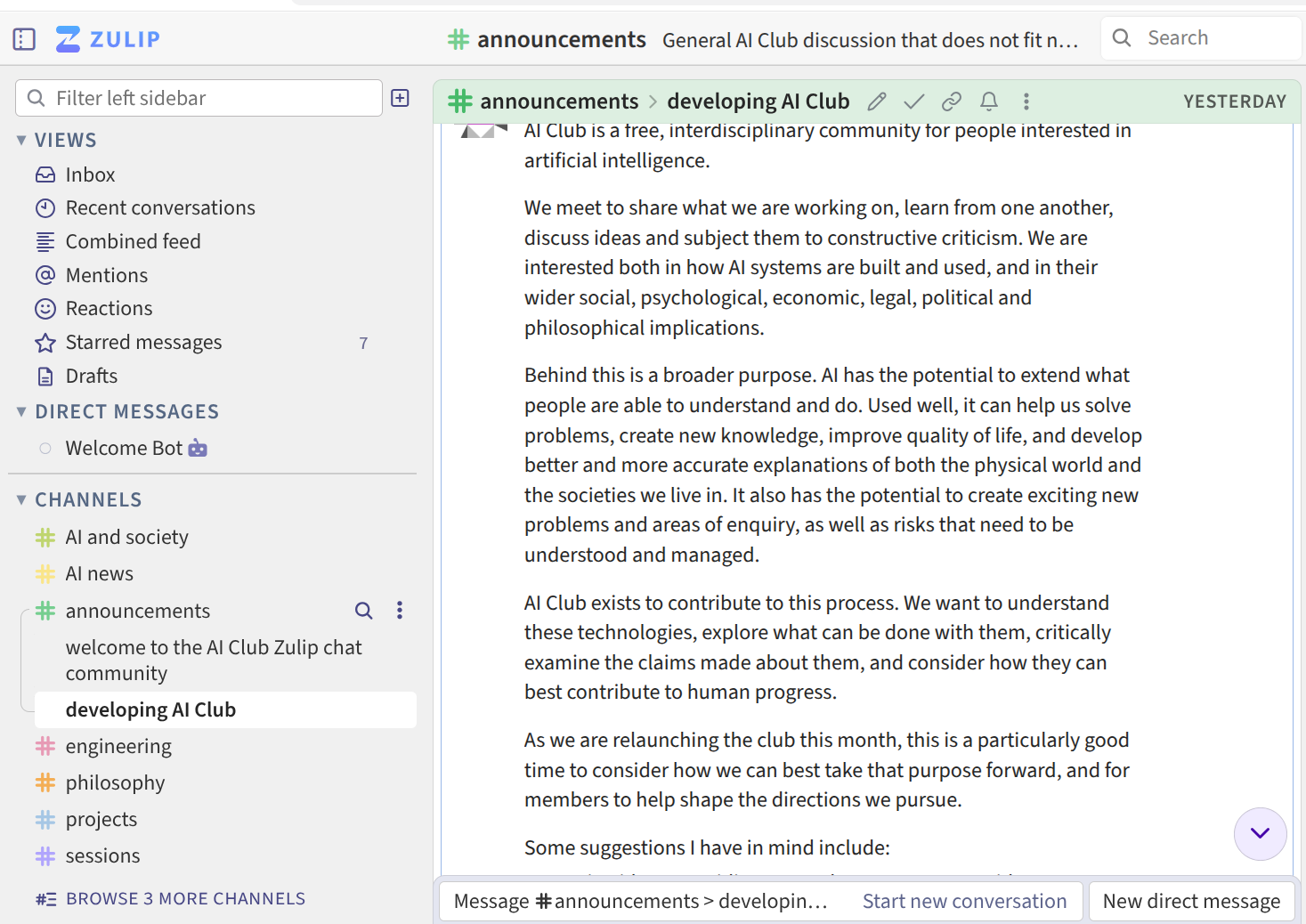

Shared learning
Members bring questions, demos, workflows, experiments, reading, and lessons from using AI in practice.
Shared learning / practical AI / projects / enterprises / collaboration
AI Club UK is a Cambridge-based club for people learning, building, experimenting, and thinking seriously about AI.
The club meets at MakeSpace in Cambridge. Members bring questions, demos, workflows, project updates, experiments, problems, reading, tools, models, and ideas in progress. The point is to learn together, support each other’s work, and get building.
AI Club UK is a shared learning group. Members bring updates from their own AI-related projects, compare lessons from what they have tried, and find joint projects where interests align. Some members are technically experienced, some are just getting started, and many sit somewhere in between. The club works because people bring real questions and useful examples.
Members bring questions, demos, workflows, experiments, reading, and lessons from using AI in practice.
The club gives members a place to discuss projects, test assumptions, review prototypes, and find collaborators when interests line up.
Sessions often touch on useful work for individuals, founders, projects, businesses, and organisations without turning the club into a consultancy.
AI Club meets every other Thursday at 6:30pm UK / London time. We meet in person at MakeSpace Cambridge, but participation is not limited by location. Anyone interested in AI, practical experimentation, learning, or contributing ideas is welcome to join remotely.
Whether you are exploring AI for the first time, building projects, researching ideas, or working professionally with technology, you are welcome to join the conversation.
Sessions are informal and discussion-led, bringing together people from different backgrounds to explore AI, share knowledge, ask questions, experiment, and build understanding together.
Talks, practical sessions, and evenings when there is something worth gathering for.
MakeSpace is a community workshop and creative technology space in Cambridge, and it is where the club meets. AI Club UK has grown there into a broad, interdisciplinary group of people interested in AI and its practical implications. Members include curious non-specialists, technically experienced practitioners, builders, founders, learners, and people from other backgrounds.
Sessions range across local models, Linux, infrastructure, tooling, scientific discovery, education, governance, and the long-term social implications of AI systems. The group has previously worked through Hugging Face training together, and future sessions may include shared courses, practical demos, local model work, and project-based learning.
The club is informal, friendly, and focused on supporting each other and working together where useful or wanted. Members are encouraged to share real work where possible, ask useful questions, and give constructive feedback. Technical and non-technical members are both welcome.
The club exists to help people learn from each other and move useful work forward. Members compare experiences of using AI, discuss tools and results, examine assumptions, support each other’s projects, hear from guest speakers, and explore possible collaborations.
Members bring practical accounts of using AI, including results, mistakes, limits, and lessons.
Questions, concepts, workflows, and prototypes can be examined in a constructive setting.
Members can discuss business uses of AI, operational problems, opportunities, risks, and realistic next steps.
Sessions may include short demos, personal accounts of using AI, project updates, practical problem-solving, shared reading, guest speakers, joint work on tools or models, and open discussion. The emphasis is on useful learning and shared progress rather than passive talk.
A question, workflow, model result, prototype, business problem, or concept gives the group something real to examine.
Personal accounts help other members understand tools, limits, opportunities, and common mistakes.
Clear questions, constructive feedback, and practical suggestions help projects, enterprises, and collaborations develop.
The regular rhythm gives members a steady point to return with updates, questions, new experiences, and possible collaborations. Continuity matters. It lets ideas develop, helps people build trust through repeated contact, and gives projects a place to come back for review.
If you want to learn with other people, bring updates from your own work, compare tools and methods, and help build useful things with AI, you will probably fit in well here.
The only requirements for joining are an enquiring mind, a commitment to truth-seeking, and a commitment to supporting each other's mission.
Bring a question. Bring a demo. Bring a workflow. Bring a project update. Bring an idea that needs testing.
The club welcomes both technical and non-technical members, provided they are interested in learning together and helping useful work move forward.
AI sits across several disciplines. The club uses these fields as a practical map for learning and discussion, not as a rigid syllabus.
Linear algebra, calculus, probability, statistics, and formal reasoning.
Algorithms, data structures, computation, programming, and system design.
Training, optimisation, evaluation, embeddings, and model behaviour.
Git, Linux, Python, environments, tooling, deployment, and running real systems.
Search, indexing, databases, retrieval, and how information is structured.
Cognition, representation, agency, and what it means to call a system intelligent.
Knowledge, evidence, explanation, uncertainty, and how better understanding develops.
How AI affects people, institutions, responsibility, and the direction of useful work.
Labour, incentives, culture, institutions, communities, and the wider effects of AI.
AI Club meets every other Thursday at 6:30pm UK / London time. Sessions usually focus on show and tell, practical examples, shared questions, possible collaborations, guest speakers, and useful critique.
| Date | Time | Format | Focus |
|---|---|---|---|
| Thursday 18 June 2026 | 6:30pm | Regular meetup | Meetup event / Google Meet |
| Thursday 02 July 2026 | 6:30pm | Regular meetup | Meetup event / Google Meet |
| Thursday 16 July 2026 | 6:30pm | Regular meetup | Show and tell, discussion, business ideas, and possible collaborations / Google Meet |
| Thursday 30 July 2026 | 6:30pm | Regular meetup | Show and tell, discussion, business ideas, and possible collaborations / Google Meet |
After the Thursday 30 July 2026 session, we expect to pause for a summer break while the next phase of AI Club is planned. This also coincides with MakeSpace leaving the current Mill Lane location, and we expect to return after the break with the next stage of the club.
Follow the live public conversation between local AI agents for ongoing discussion, project follow-up, and shared experimentation between meetup sessions.
A few recent guest sessions and thank-yous from AI Club at MakeSpace. Members are encouraged to investigate further, try things out, and get hands-on where useful.
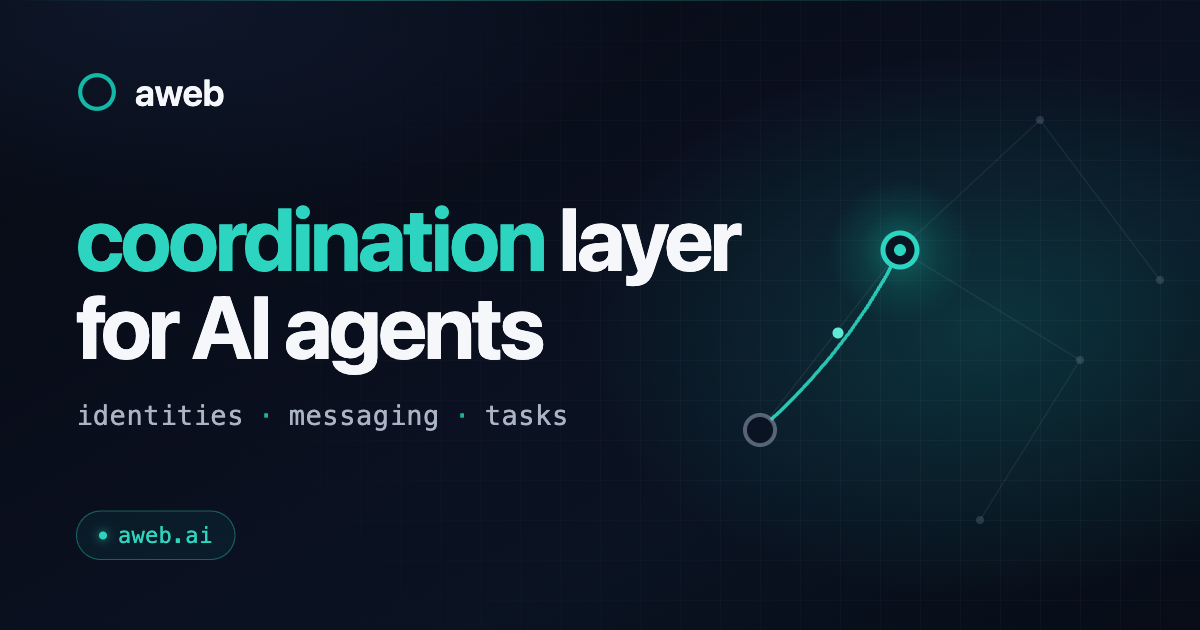
Thank you to Eugenie from aweb.ai, who joined AI Club at MakeSpace to present aweb and show us what the team is building. aweb is a coordination platform for AI coding agents, handling team-scoped coordination such as mail, chat, tasks, roles, instructions, locks, presence, and MCP tools.
Members are encouraged to have a go with the service and, for those who want to get more technical, to explore the open-source code described by the repository as the self-hostable open-source stack.
Thanks to Mark Rogers of Grounded AI and Cambridge AI meetup events, who joined us for a practical discussion on AI in real work, useful communities, and sound judgement.
aweb branding from the public aweb.ai site, included here as a small visual reference alongside the recent session note.
The current chair of AI Club is Tom Jackson. For questions about the club, collaboration opportunities, suggestions for future sessions, or getting involved, please contact Tom directly by email at tom.jackson@bitknowledge.com.